
Alpharetta Clay Soil and Your Concrete Driveway: What to Know
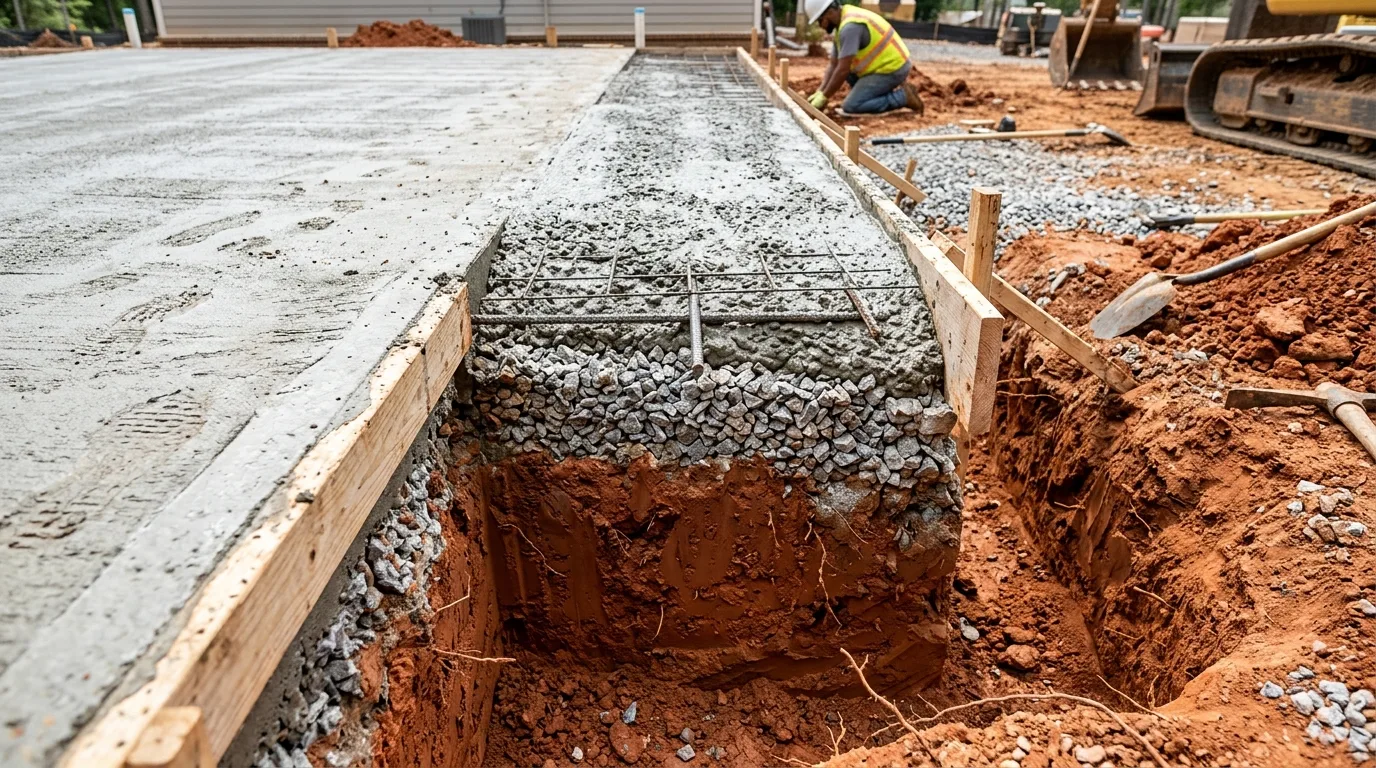
Every year, Alpharetta homeowners call for concrete repair on driveways and patios that cracked within two or three years of installation. In nearly every case, the same culprit shows up when we dig down to investigate: the soil beneath the slab was never properly prepared for what it was going to do.
In this post, we cover what Georgia’s red clay soil actually is, how it behaves under Alpharetta’s rainfall and drought patterns, and what that means for any concrete project you’re planning in Fulton County.
Planning Concrete Work in Alpharetta?
We design every pour for Alpharetta's clay soils. Call (888) 376-0955 for a free estimate.
Why Clay Soil Matters for Concrete in Alpharetta
Alpharetta’s dominant soil type is Georgia red clay — the reddish-orange soil visible at any construction site in the area. This clay isn’t just a surface feature; it extends deep into the ground across most of Fulton County. Unlike sandy soils, which allow water to drain through quickly and remain dimensionally stable, clay absorbs water and swells, then releases water and shrinks. Geologists call this shrink-swell potential, and Georgia’s red clay is classified as having moderate to high shrink-swell potential throughout the Alpharetta area.
The practical consequence for homeowners in neighborhoods like Glen Abbey and Deer Lake is that the ground beneath their concrete doesn’t stay still. When Alpharetta receives rainfall — and the city averages over 50 inches annually — the clay beneath driveways, patios, and slabs absorbs moisture and expands upward. When dry periods arrive, particularly during Georgia’s late summer stretches and winter months, the clay contracts and pulls away from the concrete above it. The concrete, which can’t follow this movement without cracking, is stressed from below with every seasonal cycle.
Types of Clay Soil Damage to Concrete
Heaving. When clay expands after heavy rain, it can push sections of concrete upward. You’ll recognize this as driveway or patio sections that are slightly higher than adjacent sections, creating an uneven surface. The joints between sections are often where this displacement is most visible.
Settlement. When clay dries and contracts, it can pull away entirely from the concrete slab, creating voids. Concrete spanning those voids cracks when load is applied — even the weight of a car on a driveway section with a void beneath it is enough to cause fracturing. This is the most common concrete repair issue in Alpharetta.
Differential settlement. This is the most damaging pattern — where different parts of the slab move by different amounts. One section stays put while an adjacent section sinks or rises. The concrete slab cracks at the differential point, and the severity depends on how much relative movement occurred.
Drainage failures. Clay’s low permeability means water stays near the surface longer than it would in sandy soils. Concrete patios and driveways that weren’t graded to drain away from the house can develop standing water at their edges — which accelerates both clay swelling and winter freeze-thaw damage.
Practical Uses: Concrete Projects Where Clay Soil Preparation Is Critical
New driveways in Windward and similar communities. Windward’s 3,400-acre master-planned layout includes many home sites on terrain with active clay at the surface. Driveways installed without proper sub-base depth — four to six inches of compacted gravel minimum — on Windward clay lots show cracking within three to five years. Proper sub-base distributes the driveway’s load over more soil area and interrupts direct contact between the concrete and the moving clay.
Patios with outdoor kitchen structures. A poured concrete patio slab beneath a built-in outdoor kitchen bears point loads from heavy stone countertops and appliances. If the clay beneath that patio develops voids, those concentrated loads will crack the slab. Extra reinforcement and sub-base depth are essential for patio slabs bearing structural elements.
Retaining walls on sloped lots. The clay soil’s movement behavior adds lateral pressure behind retaining walls beyond what the soil weight alone would suggest. Retaining walls in Alpharetta need drainage behind them specifically to keep the clay as dry as possible — reducing both the weight and the expansive pressure on the wall face.
Foundation slabs for additions and detached structures. An improperly prepared foundation slab in Alpharetta’s clay environment doesn’t fail dramatically — it fails slowly, showing itself in sticking doors, floor cracks, and gradually worsening symptoms over years. The repair at that stage is far more expensive than the engineering investment at the beginning.
How We Engineer Concrete Pours for Alpharetta Clay
The starting point is getting the clay out of the load-bearing layer beneath the concrete. This means removing the native clay down to a depth adequate for the project and replacing it with compacted gravel that stays dimensionally stable regardless of moisture content. For driveways, that typically means four to six inches of compacted crusher run gravel. For foundation slabs, it may mean excavating deeper to reach residual soil with lower clay content.
The next layer of protection is drainage. Grading the site so that water runs away from the slab prevents the clay from saturating repeatedly. For patios and driveways, this means a minimum slope of 1/8 inch per foot away from the structure. For retaining walls, it means installing perforated drain pipe behind the wall face with a gravel drainage layer to collect and redirect water before it saturates the clay and builds pressure.
Reinforcement — rebar or fiber mesh — doesn’t prevent clay movement. It holds the concrete together if the clay moves anyway, so that instead of the slab breaking into separate pieces, it develops controlled cracks at the joints rather than random fracturing. Control joint placement is also critical for managing where cracking occurs as the slab responds to the clay below.
Concrete on Clay Soil in Alpharetta — Done Right
Every pour engineered for Fulton County's conditions. Call (888) 376-0955 or request your free estimate online.
What Affects the Cost of Proper Clay Soil Preparation
Proper sub-base preparation for Alpharetta clay soil adds cost to any concrete project — there’s no way around it. Excavating native clay and replacing it with compacted gravel costs more than pouring directly on whatever soil is present. That added cost is why some contractors in the Alpharetta market skip or minimize it — their bids look better, but their driveways and patios look worse within a few years.
For a standard two-car driveway in Alpharetta, concrete driveway cost including adequate sub-base preparation runs $8–$18 per square foot. The sub-base component typically represents $1.50–$3.00 of that total. Skipping it might save $900–$1,800 on a 600-square-foot driveway — but the repair or replacement cost when the slab fails prematurely is multiples of that savings. Georgia’s construction costs run roughly 9% below the national average, keeping these costs competitive even when proper preparation is included.
When getting estimates for concrete work in Alpharetta, ask every contractor specifically: what is the sub-base depth and material, and what equipment will you use to compact it? The answers will tell you immediately how seriously they’re taking the local soil conditions.
Frequently Asked Questions
Why do so many Alpharetta driveways crack within a few years?
The most common reason is inadequate sub-base preparation for clay soil. Contractors who don’t excavate the native clay and replace it with properly compacted gravel leave a slab sitting directly on soil that will move with every wet-dry cycle. Alpharetta’s 50+ inches of annual rainfall makes this cycle frequent and significant. See our concrete repair page for information on addressing damage that’s already occurred.
Can I tell if my concrete was installed on proper sub-base?
You can’t easily see sub-base quality after the fact, but you can look for indicators: does the concrete feel solid underfoot with no flex or movement? Are control joints clean and intact? Is there evidence of drainage away from the slab? If the concrete is rocking slightly or you can hear a hollow sound beneath sections when you tap them, voiding has likely developed under the slab. Read our concrete repair guide to understand your options.
Does Georgia red clay affect foundation slabs differently than driveways?
Yes — foundation slabs are more consequential because they bear the weight of the structure above. Clay movement beneath a foundation slab manifests as differential settlement, which causes structural symptoms: sticking doors, floor cracks, separation at wall corners. The concrete slab foundation page covers the engineering approaches that address Alpharetta’s clay soil in foundation applications.
Alpharetta Concrete Built for Georgia Clay
Call Alpharetta Concrete Contractors at (888) 376-0955 — proper sub-base, proper reinforcement, proper results.
Related: