
Alpharetta Concrete Repair: What Homeowners Need to Know
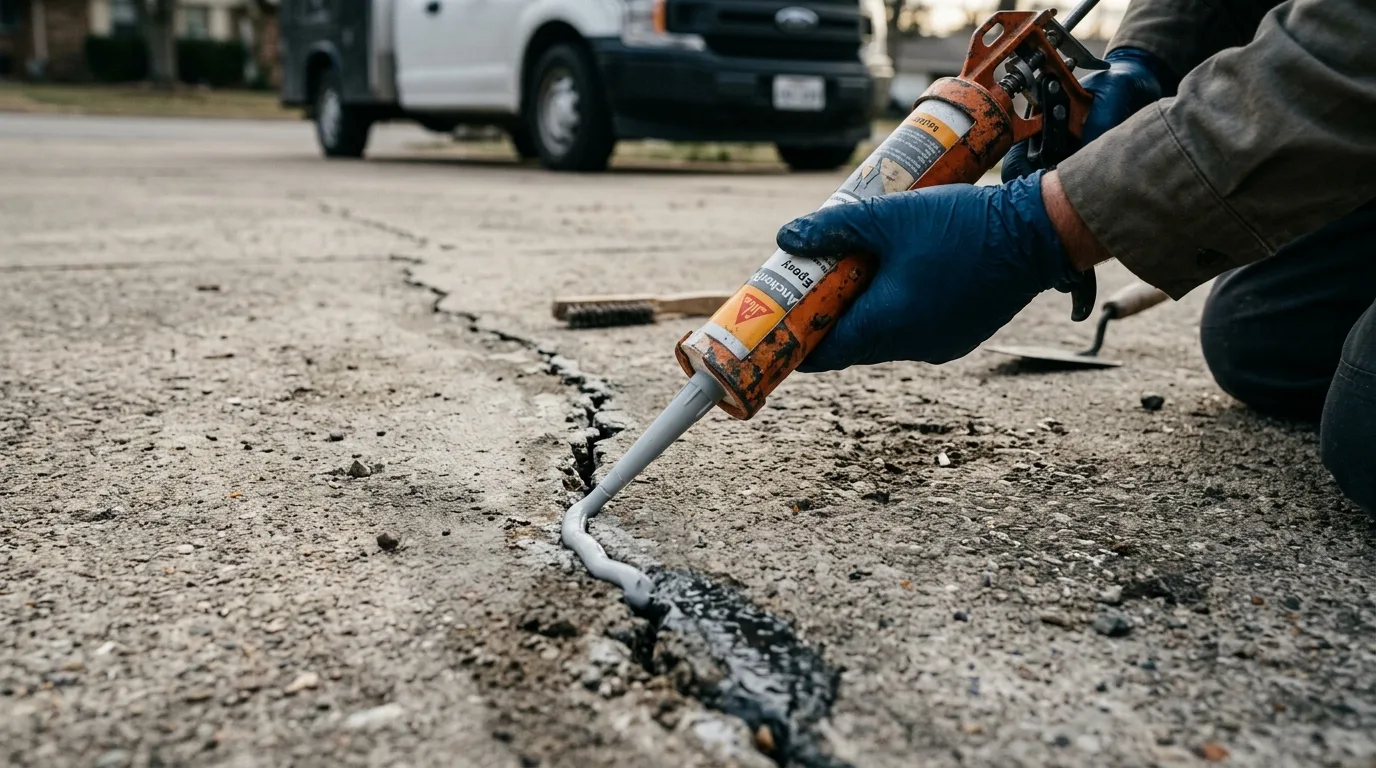
That crack in your Alpharetta driveway has been there since winter. The corner of your patio has settled half an inch. A section of the walkway spalled last spring, and now you’re wondering whether to fix it or leave it alone. In Alpharetta’s clay soil environment, the “leave it alone” option has a predictable outcome — the damage gets worse with every rain season and every winter freeze.
In this post, we explain what concrete repair options exist for Alpharetta properties, how to tell which type of repair matches which type of damage, and what same-day and multi-day concrete repair work actually costs in Fulton County.
Free Concrete Repair Assessment in Alpharetta
Honest diagnosis with no-pressure recommendations. Call (888) 376-0955.
Why Acting on Concrete Repair Quickly Matters in Alpharetta
The case for prompt concrete repair in Alpharetta is simple: the conditions that cause the initial damage — clay soil movement and freeze-thaw cycling — continue to act on any damage that’s already present. A quarter-inch crack fills with water during Alpharetta’s 50+ inches of annual rainfall. That water freezes during January’s 29°F average lows, expands, and pries the crack wider. By the following spring, a crack that cost $150–$300 to fill in the fall now costs $400–$600 to address, and the water that worked beneath the slab through the widened crack has begun saturating the clay sub-base.
The repair cost curve in Alpharetta is not linear — it accelerates because each phase of damage creates conditions for the next, more expensive phase.
Concrete Repair Types and When Each Applies
Crack filling. The most common concrete repair service for Alpharetta homeowners. Isolated cracks up to half an inch wide are cleaned, dried, and filled with flexible polyurethane or epoxy. Polyurethane filler remains slightly flexible after cure, which is appropriate for cracks in clay soil environments where small ongoing movement is likely. Epoxy provides a rigid, high-strength fill better suited to static cracks where movement has stopped. Crack filling cost: $150–$500 for isolated repairs.
Spall repair. Areas where the surface concrete layer has broken away, exposing the aggregate beneath, are addressed with polymer-modified mortar. The damaged area is cleaned, profiled, and the mortar is applied in layers to rebuild the surface to grade. For Alpharetta’s freeze-thaw climate, mortar products with adequate air entrainment and flexibility for thermal movement perform best. Spall repair cost: $3–$8 per square foot of affected area.
Slab lifting (mudjacking or polyurethane foam). Settled sections of concrete — sections that have dropped relative to adjacent slabs — can be lifted by injecting material beneath the slab. Mudjacking pumps a cement-soil slurry; polyurethane foam injection uses expanding foam through small drilled holes. Both lift the slab by filling the void beneath it. Polyurethane foam is faster and lighter (less added weight on the clay sub-base) — a meaningful advantage in Alpharetta where sub-base re-settlement is a concern. Slab lifting cost: $800–$2,500 for a typical residential project.
Resurfacing overlay. When surface deterioration covers more than a third of the slab area, full surface resurfacing with a bonded overlay makes more sense than multiple individual spall repairs. The slab must be structurally sound for resurfacing to be a viable option. Resurfacing cost: $3–$7 per square foot.
Practical Uses: Matching Damage to the Right Repair
Driveway cracks in a Windward home. Two or three isolated cracks in an otherwise solid driveway surface are crack fill candidates. The slab passes the flex test (no movement when a car drives over it), the cracks have been stable in width for a year, and there’s no sign of voiding beneath. Schedule the fill in September before Alpharetta’s first freeze. This is a same-day repair in most cases.
Settled patio section near a Glen Abbey home. A rear patio section that settled after last spring’s heavy rains — about half an inch below adjacent sections, creating a drainage low point — is a candidate for polyurethane foam lifting if the rest of the slab is sound. The lifting returns it to grade, and drainage correction prevents the clay saturation that caused the settlement from repeating.
Spalled pool deck surrounding a Crooked Creek property. A pool deck where the top layer has scaled and flaked across 40% of the surface needs resurfacing rather than individual spall patches. The underlying slab is sound, drainage is correct, but the surface deteriorated from years of pool chemical exposure and UV without adequate sealing. Resurfacing plus a penetrating sealer restores the surface and adds a sealing schedule to prevent recurrence.
Networked cracking across a 20-year-old driveway in Alpharetta. Multiple cracks across the full slab width in a stair-step or branching pattern indicate sub-base failure — not just surface damage. Crack filling alone won’t hold when the cause is ongoing sub-base movement. This scenario warrants a full replacement assessment. See our signs your driveway needs replacement guide for the full criteria.
Concrete Repair in Alpharetta — Same-Day Available
Call (888) 376-0955 for a free assessment. We tell you exactly what repair approach makes sense.
How Alpharetta’s Climate Affects Concrete Repair Timing
Best time for crack filling: September through October, before winter freeze season. Filling cracks in the fall prevents freeze-thaw expansion from widening them through winter. This is the single most cost-effective concrete maintenance step for Alpharetta properties.
Best time for resurfacing: Fall (September–November) when humidity is lower and temperatures are stable. Resurfacing overlays bond better in moderate temperatures and require at least 48 hours of dry weather before and after application — conditions more reliably available in Alpharetta’s fall than in spring’s wetter pattern.
Best time for slab lifting: Spring or fall, when temperatures are mild and the clay is not at its most saturated state. Lifting during mid-winter (when clay may be partially frozen) or in July’s heat affects material performance.
What Affects Concrete Repair Cost in Alpharetta
Crack filling in Alpharetta runs $150–$500 for isolated repairs. Spall repair runs $3–$8 per square foot. Slab lifting runs $800–$2,500. Full resurfacing runs $3–$7 per square foot. Full replacement of driveways that are beyond repair runs $8–$18 per square foot.
The most important cost consideration is whether addressing the root cause is part of the repair plan. In Alpharetta’s clay soil environment, surface repairs that don’t address drainage issues or sub-base voids cost approximately what they would cost to repair correctly — and then fail within one to two wet seasons, requiring the same work again. We include drainage assessment in every concrete repair evaluation and include recommendations for root cause correction in our proposals.
Frequently Asked Questions
How much does concrete crack repair cost in Alpharetta?
Isolated crack filling in Alpharetta costs $150–$500 depending on crack length, depth, and whether drainage issues need to be addressed at the same time. Polyurethane crack filler for residential applications is the most common product in the Alpharetta market — it remains slightly flexible after cure, which is appropriate for clay soil environments where small ongoing movement is possible. Contact us for a free assessment of your specific repair situation.
Can concrete cracks be repaired permanently in Alpharetta?
Crack repairs can be permanent if the underlying cause is addressed. A crack caused by normal thermal movement at a control joint that’s been properly filled with the right product will stay filled indefinitely. A crack caused by ongoing clay soil movement or drainage failure will re-open after filling because the force creating it is still active. Our assessment process identifies whether the crack’s cause has stabilized before recommending a repair approach.
When should I repair concrete instead of replacing it in Alpharetta?
Repair is appropriate for isolated cracks, surface spalling over a limited area, and modest settlement of less than half an inch with a sound sub-base. Replacement is more appropriate for networked cracking, settlement over an inch, heaving, or spalling across more than 25% of the surface. See our concrete repair service page for a complete assessment of repair versus replacement criteria.
Concrete Repair Done Right in Alpharetta, GA
Call Alpharetta Concrete Contractors at (888) 376-0955. Honest assessments, lasting repairs.
Related: