
Alpharetta Concrete Slab Foundations: Cost, Process, Timeline
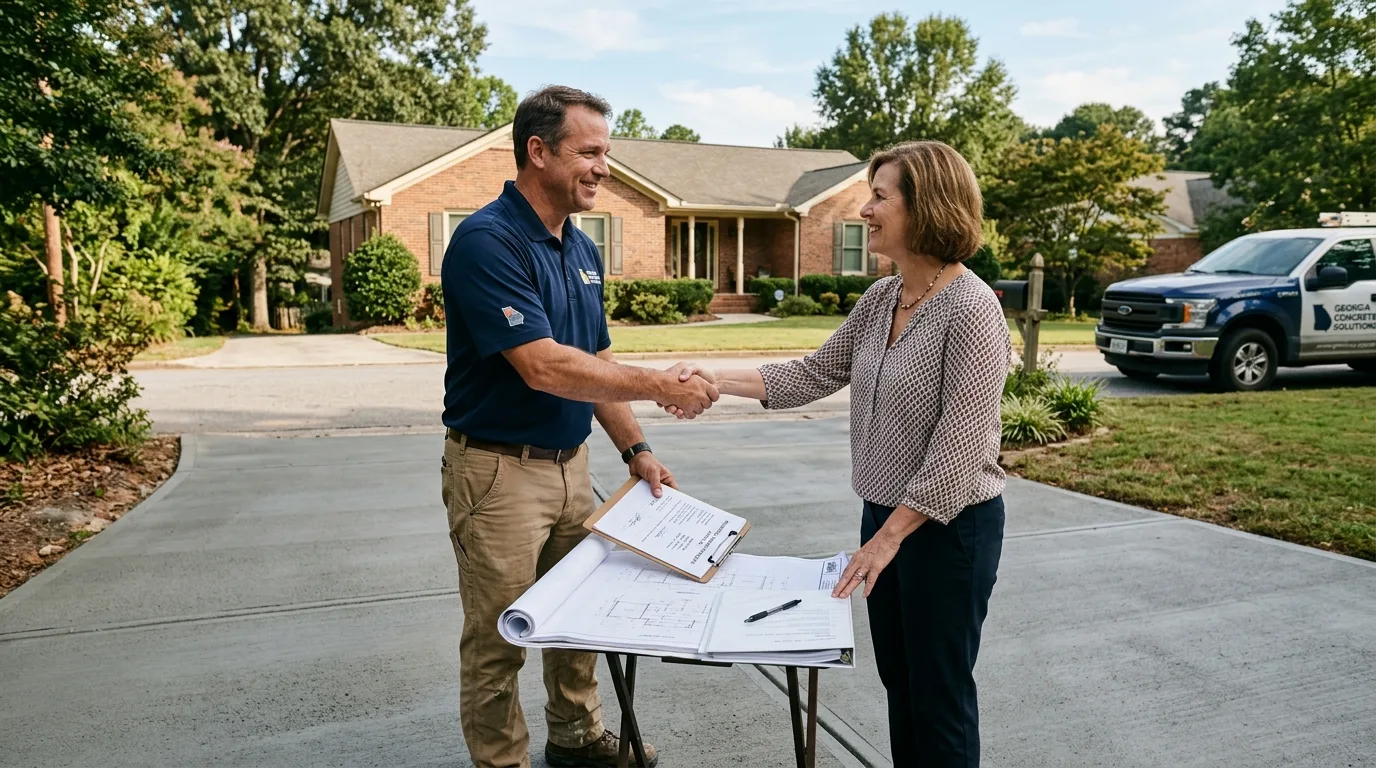
When a new structure goes up in Alpharetta — whether it’s a home addition, a detached garage, or an accessory dwelling unit — the foundation slab decision made at the start determines how the structure performs for the next 50 years. In Fulton County’s clay soil environment, that decision is more consequential than it is in many other Georgia markets.
In this post, we break down the concrete slab foundation process for Alpharetta projects: what each construction phase involves, how costs break down, how long the work takes, and what the engineering requirements specific to Alpharetta’s clay soil actually are.
Concrete Slab Foundation Estimates in Alpharetta
Site evaluation and clay soil assessment included with every proposal. Call (888) 376-0955.
Why Slab Foundation Engineering Is Different in Alpharetta
Foundation work in most of Georgia involves standard slab-on-grade construction with conventional sub-base preparation. Alpharetta’s expansive red clay creates a more demanding engineering environment. Georgia’s red clay has a shrink-swell classification that puts it in the moderate-to-high range — meaning the soil’s volume change potential from wet to dry conditions is large enough to exert measurable upward and downward forces on any concrete slab resting on it.
For foundation slabs in Windward and similar Alpharetta communities built on active clay terrain, this means standard four-inch slab specifications on native clay are insufficient. The result is foundation movement that shows itself through sticking doors, floor cracking, and stair-step wall cracking within five to twenty years of construction. The Engineering Professionals who work on foundation repair in Alpharetta consistently trace these symptoms back to original slabs that didn’t address clay conditions at the design stage.
Addressing clay at the design stage costs less than foundation repair after the fact — in some cases significantly less.
The Concrete Slab Foundation Process in Alpharetta
Phase 1: Site evaluation and soil assessment. Before any excavation begins, understanding the clay profile on the specific lot matters. Different areas of Alpharetta have different clay depths and activity levels — a lot near Deer Lake with higher water table involvement may need different soil treatment than a lot on higher ground near the Ameris Bank Amphitheatre corridor. We discuss soil conditions during the estimate process and flag when engineering assessment is warranted.
Phase 2: Excavation and soil treatment. The native clay is excavated to the design depth. Depending on the soil assessment, this may include lime or cement stabilization of the clay layer before the gravel sub-base is placed. Lime stabilization involves adding calcium oxide to the clay, which chemically modifies it to reduce shrink-swell potential. It’s an added cost but provides a meaningfully more stable base for the slab than unmodified clay.
Phase 3: Sub-base installation. Compacted gravel (typically four to eight inches depending on project specifications) is placed and mechanically compacted. This layer provides load distribution, drainage, and a stable working surface that minimizes direct contact between the concrete and the moving clay.
Phase 4: Vapor barrier and drainage. A polyethylene vapor barrier prevents moisture migration from the ground into the slab. For foundation slabs, this moisture barrier is important both for slab durability and for the building’s interior moisture conditions above.
Phase 5: Forming, reinforcement placement, and pre-pour inspection. Forms are set to define the slab perimeter and any thickened sections (grade beams at the perimeter and interior load-bearing lines). Rebar or post-tensioned cable is placed per the structural design. City of Alpharetta inspection of the reinforcement before the pour is required for foundation work — schedule by calling 678-297-6080 between 7:30 and 8:30 AM.
Phase 6: Concrete pour. The slab is poured monolithically where possible to avoid cold joints. Mix design, slump, and placement timing are managed to the weather conditions of the pour day. For foundation slabs, the large thermal mass requires careful cure management.
Phase 7: Curing. The slab must cure for a minimum of seven days before construction loads are applied. Full 28-day strength is required before heavy point loads. In Alpharetta’s summer heat, wet curing methods may be used for large foundation slabs to prevent differential drying.
Practical Uses: Foundation Slab Applications in Alpharetta
Home additions. The most common foundation slab project in Alpharetta is an addition to an existing home — a bonus room over the garage, a first-floor addition, or a sunroom addition. The new slab must match the existing slab height and specification. On clay soil, the new slab needs the same engineering as the original should have received, even if the original didn’t include it.
Detached garages and workshops. Alpharetta’s large lots increasingly feature detached garages, workshops, or she-sheds. These accessory structures require foundation slabs that meet city building code requirements and are designed for the intended load — a workshop with a car lift needs a different slab than a storage shed.
ADU (accessory dwelling unit) construction. Alpharetta’s recent zoning changes have expanded ADU allowances. ADU foundation slabs must meet residential building code requirements and are subject to full building permit and inspection processes including the pre-pour foundation inspection.
New construction foundation. New home construction in Alpharetta sometimes uses slab-on-grade foundations rather than crawl space or basement designs. Full engineering is standard for residential new construction — the clay soil engineering requirements are well-understood by residential builders in the Alpharetta market.
Foundation Slab Planning in Alpharetta, GA
Clay soil assessment included with every foundation proposal. Call (888) 376-0955.
Concrete Slab Foundation Costs in Alpharetta
Standard residential concrete slab foundations in Alpharetta cost $5–$11 per square foot. A 1,000-square-foot slab runs $5,000–$11,000 for the concrete work component. A 2,000-square-foot foundation for a full home runs $10,000–$22,000.
The primary cost variables above the base concrete rate are:
- Soil treatment. Lime stabilization adds $1.50–$3.00 per square foot to the base cost but is often the right investment in active clay areas.
- Slab thickness. A six-inch slab costs more than four-inch per cubic yard of concrete. For garages and structures bearing equipment loads, six-inch is the standard.
- Footing depth. Deeper perimeter footings required by active clay sites add concrete and excavation cost.
- Post-tensioned vs. rebar. Post-tensioned cable systems are more expensive to install but allow thinner slabs while maintaining performance in clay soil environments.
- Vapor barrier and drainage. Standard additions that add nominal cost but are essential for slab durability and building performance.
Fulton County construction costs run approximately 9% below the national average, keeping Alpharetta foundation work competitively priced relative to higher-cost Georgia markets. Concrete delivery in the area runs $1,200–$1,551 per 10-yard truck.
Frequently Asked Questions
How much does a concrete slab foundation cost in Alpharetta?
Standard residential concrete slab foundations in Alpharetta cost $5–$11 per square foot. A 1,000-square-foot slab runs $5,000–$11,000. The main variables above base pricing are soil treatment requirements, slab thickness, footing depth for clay soil sites, and vapor barrier and drainage system costs. We provide itemized written estimates covering all components for every foundation project.
How long does slab foundation work take in Alpharetta?
Site preparation and forming takes two to three days. The pour itself takes one day for a standard residential slab. Concrete must cure for seven days minimum before framing loads are applied, and full 28-day strength is required before heavy point loads. Soil stabilization, if needed, adds several days. Georgia’s spring rain season can cause scheduling delays, and we don’t pour foundation slabs when significant rain is forecast within 24 hours.
What permits are required for slab foundation work in Alpharetta?
All structural concrete work including slab foundations requires a City of Alpharetta building permit and multiple inspections. Foundation work requires pre-pour inspection after rebar is placed (before the pour) and a post-pour inspection. Inspection scheduling requires calling 678-297-6080 between 7:30 and 8:30 AM. Permit fees are a minimum of $50 per permit. We handle permit applications and inspection coordination for all foundation projects. Read our concrete slab foundation service page for the full scope of what foundation projects involve.
Concrete Slab Foundations in Alpharetta Built to Last
Call Alpharetta Concrete Contractors at (888) 376-0955. Serving Alpharetta, Milton, Johns Creek, and all of Fulton County.
Related: