
Alpharetta Retaining Walls: Permits, Soil, and Installation Guide
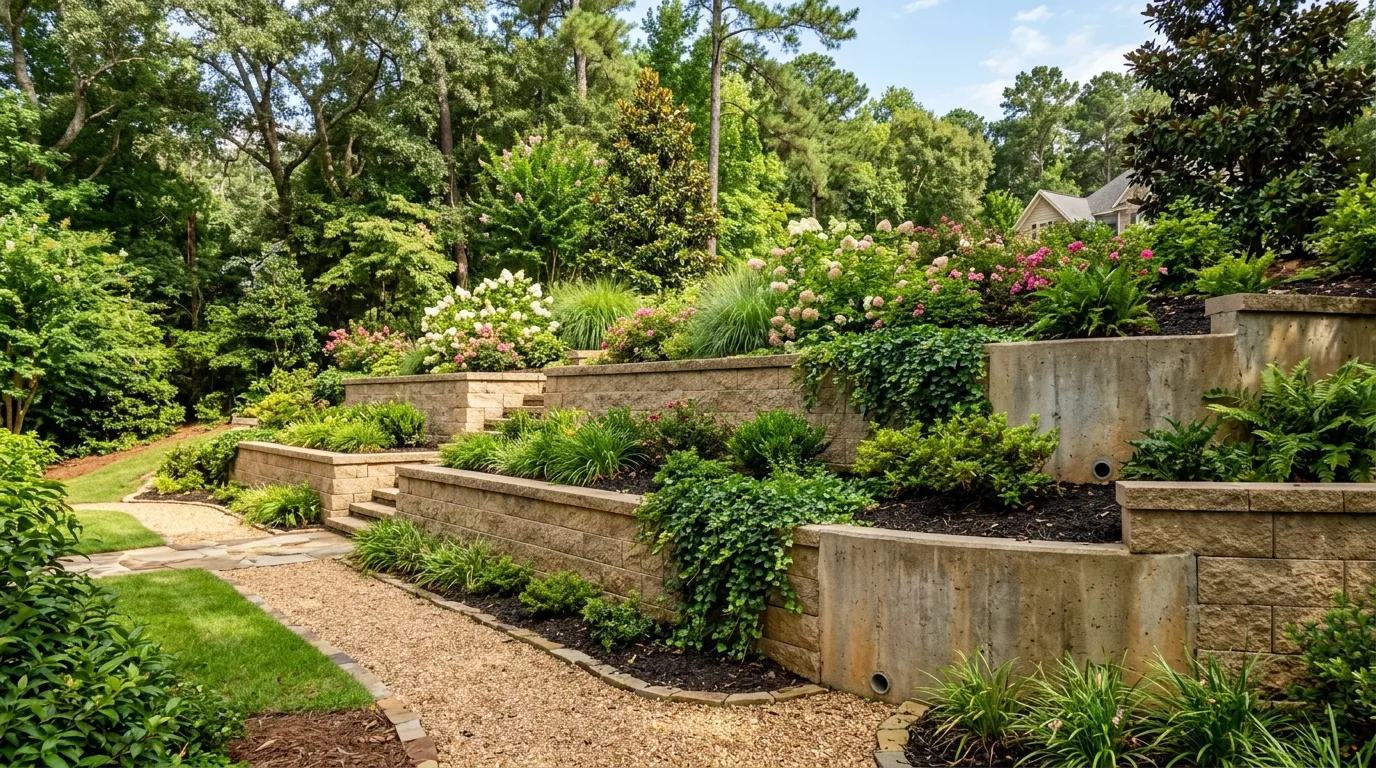
Retaining walls on Alpharetta’s rolling lots serve a function that matters year-round — controlling erosion from the city’s 50+ inches of annual rainfall, creating usable flat space on sloped lots, and protecting driveways and structures from soil movement. But a retaining wall that isn’t designed for Alpharetta’s clay soil and heavy rainfall is a countdown to failure, and failure means soil, stone, and concrete moving in directions you don’t want.
In this post, we cover the City of Alpharetta’s specific permit requirements for retaining walls, how clay soil and rainfall affect wall design, and what to expect from the installation process.
Free Retaining Wall Assessment in Alpharetta
Site visit, drainage evaluation, and permit guidance included. Call (888) 376-0955.
Alpharetta’s Retaining Wall Permit Requirements
The City of Alpharetta is explicit about retaining wall permits: walls over four feet in height require a building permit before construction begins. This rule applies citywide, including for properties within Alpharetta’s many HOA-governed communities like Windward and Crooked Creek.
The permit process for retaining walls over four feet typically involves:
Permit application. Submit to the City of Alpharetta Building and Permitting Department with project drawings showing wall height, length, location on the lot, and footing design. Walls over a certain height may require engineer-stamped structural plans.
Permit fee. Minimum $50 per permit for commercial projects; residential permit fees are calculated based on project valuation.
Inspection scheduling. Call 678-297-6080 between 7:30 and 8:30 AM on the day of inspection. Retaining wall projects typically require a footing inspection (before the footing is poured), a drainage inspection (before backfilling), and a final inspection.
HOA review. If your property is in an HOA community, architectural review board approval may be required separately. HOA approval must often be received before the city permit is even submitted.
For walls under four feet, we recommend checking with the city before assuming no permit is needed. Properties within subdivisions are subject to the general subdivision construction permit requirement, and individual site factors can affect whether a permit applies.
Why Drainage Defines Retaining Wall Performance in Alpharetta
If we could give Alpharetta homeowners one piece of retaining wall advice, it would be this: a retaining wall without drainage behind it is not a wall — it’s a dam that will eventually fail.
Alpharetta receives over 50 inches of rain annually — more than Seattle — and the city’s clay soil has very low permeability. When rain falls on a slope, the clay absorbs what it can and then allows the rest to flow. Without drainage behind a retaining wall, that flowing water has nowhere to go except against the wall face, building hydrostatic pressure with every rainfall event. Clay soil that’s fully saturated behind a wall exerts hundreds of pounds per square foot of lateral force — far more than the soil weight calculation alone would suggest.
The neighborhoods around Glen Abbey and Deer Lake, which have lower-lying terrain with higher water tables, are particularly vulnerable to retaining wall failures caused by inadequate drainage. Walls in these areas can accumulate hydrostatic pressure faster than walls in higher, better-draining locations. The drainage design has to account for the specific site’s drainage catchment area, not just the wall’s face area.
Types of Retaining Walls and Their Applications in Alpharetta
Poured concrete walls. The strongest and longest-lasting option for Alpharetta’s clay soil and rainfall environment. A poured concrete retaining wall functions as a monolithic gravity structure — its mass resists the lateral pressure from retained soil. Poured walls can be finished smooth, textured, or faced with decorative stone veneer. They’re the preferred choice for walls over three feet in height where maximum longevity is the priority.
Concrete masonry unit (CMU) block walls. Hollow concrete block filled with rebar and concrete provides good strength at moderate cost. Used extensively in Alpharetta for mid-height retaining walls in residential applications. Less expensive than poured concrete but requires more precise drainage design because block walls have more potential failure points at the mortar joints.
Segmental retaining wall block (Allan Block, Versa-Lok, etc.). Modular concrete block systems that stack without mortar, relying on batter (backward lean), depth of burial, and geogrid reinforcement layers for stability. Practical for walls up to three to four feet in height. Above that, geogrid reinforcement is required and the engineering becomes more complex. The block systems are available in numerous finishes and colors suitable for residential landscaping in communities like White Columns Country Club.
Practical Uses: Matching Wall Type to Alpharetta Lots
Erosion control on a side yard slope. A lot with a 15-foot slope between the house and property line needs a tiered approach — two or three shorter walls set back from each other rather than one tall wall. Tiered walls reduce the lateral pressure on each individual wall and make drainage installation straightforward. Poured concrete or CMU block works well for this application.
Driveway cut retaining. When a driveway cuts into a slope, the cut face needs to be retained immediately. This is a common application in the Alpharetta-Milton corridor where many lots have natural grade changes along the driveway line. Poured concrete provides the cleanest finish and best longevity for driveway-adjacent walls.
Backyard leveling for patio area. Retaining one or two feet to create a level patio area behind the house is one of the most common retaining wall applications in Alpharetta. Segmental block is often appropriate at these heights and provides design flexibility for curved or shaped walls. The drainage behind the wall is still essential even for lower walls — a two-foot wall with saturated clay behind it can develop significant hydrostatic pressure.
Steep lot stabilization. Large height differences — six feet or more across a residential lot — require engineered retaining solutions. Tiered walls with detailed drainage plans, possibly combined with surface drainage improvements, address the soil stability needs while managing the drainage loads that Alpharetta’s rainfall creates.
Drainage-Engineered Retaining Walls in Alpharetta
Call (888) 376-0955 for a free site assessment. We design drainage into every wall from the start.
What Affects Retaining Wall Cost in Alpharetta
Concrete retaining walls in Alpharetta typically cost $30–$60 per square foot of wall face. A 20-foot long, 4-foot tall wall — right at the permit threshold — runs approximately $2,400–$4,800. Poured concrete walls cost more than block walls per square foot but offer the longest lifespan and strongest performance in Fulton County’s clay and rainfall environment.
The primary cost factors beyond material choice are:
- Wall height (taller walls require deeper footings and more reinforcement per linear foot)
- Drainage system scope (gravel backfill, perforated pipe, outlet trenching)
- Site access (difficult access on steep slopes adds equipment cost)
- Whether the project is standalone or combined with other concrete work like a patio or driveway
Drainage installation — gravel drainage layer, perforated pipe, and outlet — is essential and adds cost, but far less cost than the wall repair or reconstruction that inevitably follows drainage failure. Projects in Roswell and Cumming on similar terrain run comparable pricing. We provide itemized estimates that separate wall construction costs from drainage system costs.
Frequently Asked Questions
Do I need a permit for a retaining wall in Alpharetta?
Retaining walls over four feet in height require a building permit from the City of Alpharetta. This is explicitly stated in city construction guidelines. For walls under four feet, permit requirements depend on location and site conditions — properties within subdivisions are subject to the general subdivision construction requirement. Always check before assuming a permit isn’t needed. We advise on permit requirements during the estimate and handle all permit applications and inspection coordination. Read our full concrete permit guide for more detail.
How much does a retaining wall cost in Alpharetta?
Concrete retaining walls in Alpharetta run $30–$60 per square foot of wall face. A 20-foot by 4-foot wall costs $2,400–$4,800. Taller walls cost proportionally more per linear foot due to footing depth and reinforcement requirements. Drainage system installation — gravel backfill, perforated pipe, outlet — is essential in Alpharetta’s rainfall environment and adds to the total. We provide detailed written estimates covering all cost components.
What drainage does a retaining wall need in Alpharetta?
Every retaining wall in Alpharetta needs a gravel drainage layer behind the wall face (typically 12 inches of clean stone), a perforated drainage pipe at the base of the drainage layer to collect and redirect water, and an outlet that directs collected water to daylight away from the wall base. Weep holes through the wall face provide secondary drainage relief. In sites with high water tables or large drainage catchment areas (common in lower-lying Alpharetta neighborhoods), additional drainage capacity may be needed. Our retaining wall service page covers drainage design in more detail.
Alpharetta Retaining Wall Experts
Call Alpharetta Concrete Contractors at (888) 376-0955. Permit coordination included with every wall project.
Related: