
5 Signs Your Alpharetta Driveway Needs Replacement Not Repair
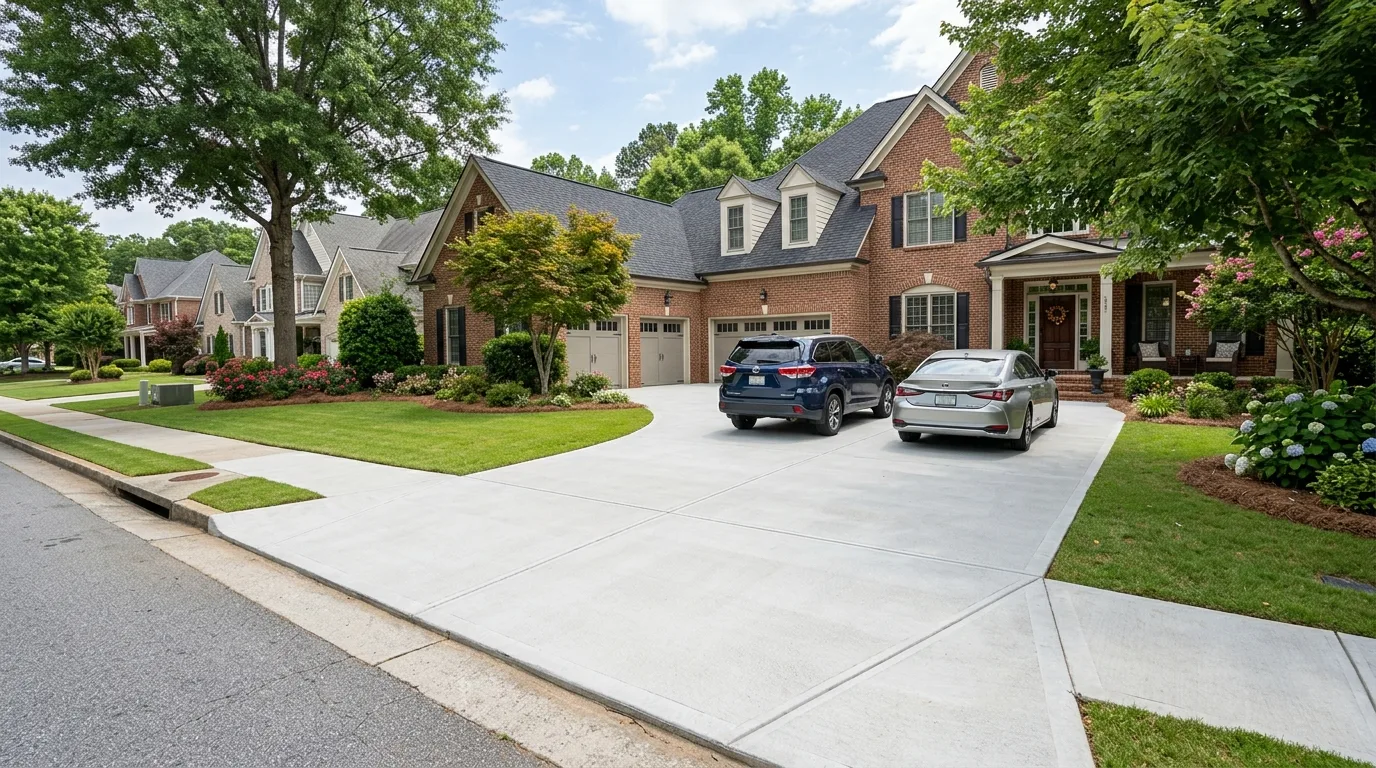
A cracked or uneven driveway in Alpharetta is usually the result of one thing: Georgia’s expansive red clay soil doing what it does — moving with every rain and dry spell, pushing sections up during wet periods and pulling away during dry ones. The question most homeowners face isn’t whether the driveway is damaged. It’s whether a repair will hold, or whether the underlying conditions have progressed to the point where replacement is the honest answer.
In this post, we cover five specific signs that your Alpharetta driveway has moved past the repair threshold, and explain why patching those conditions leads to repeated costs rather than a lasting fix.
Free Driveway Assessment in Alpharetta
Honest repair vs. replacement evaluation — no sales pressure. Call (888) 376-0955.
Why Alpharetta Driveways Fail Faster Than They Should
Alpharetta homeowners in Fulton County deal with a combination of factors that accelerates driveway deterioration compared to many other markets. The clay soil beneath the driveway expands and contracts with Alpharetta’s seasonal moisture swings — the city receives over 50 inches of rain annually, and the contrast between wet season saturation and dry period drought is significant. This movement stresses the slab from below with every cycle.
Layered on top of that is Alpharetta’s freeze-thaw exposure. January average lows of 29°F mean water that enters surface cracks freezes overnight, expands, and pries those cracks wider each cycle. By spring, cracks that were hairlines in October can be a quarter-inch wide or more.
When a contractor patches cracks on a driveway where these underlying forces are still active, the patch fails when the next stress cycle pushes through it. Understanding the difference between damage that patching can address versus damage that indicates sub-base failure is the key to making the right decision.
Sign 1: Multiple Wide Cracks in a Networked Pattern
Isolated cracks — a single crack running across a control joint, or a crack that follows a predictable line — are normal for concrete and represent the repair scenario where crack filling makes sense. A networked pattern of cracking across multiple sections, sometimes called “alligator cracking,” indicates that the sub-base beneath the slab has failed comprehensively rather than at a single point.
When Alpharetta’s clay sub-base develops widespread voids or uneven settlement, the concrete above it loses uniform support and cracks in multiple places simultaneously as loads flex the unsupported slab. Filling those individual cracks doesn’t restore the sub-base support — the filled cracks re-open or new cracks develop as the unsupported concrete continues to flex. Replacement with proper sub-base preparation is the correct solution for networked cracking.
Sign 2: Sections That Have Settled More Than an Inch
A section of driveway that has sunk an inch or more relative to adjacent sections has experienced significant sub-base failure beneath it. The clay has either contracted dramatically, creating a void, or experienced differential movement where different areas of the sub-base moved by different amounts. Slab lifting (mudjacking or polyurethane foam injection) can sometimes address modest settlement — quarter-inch to half-inch differences — but settlement over an inch indicates a sub-base that can’t reliably support the slab long-term even after lifting.
In Alpharetta neighborhoods like Deer Lake and Glen Abbey where water tables are higher and clay activity more pronounced, deeper settlement is more common than in areas with better-draining soils. A section that has settled by an inch today will typically continue settling without sub-base remediation that goes beyond slab lifting.
Sign 3: Concrete That Has Heaved (Risen Higher Than Adjacent Sections)
Concrete that has heaved upward is the opposite of settlement, but equally indicates sub-base disruption. Heaving happens when the clay beneath the slab expands significantly, pushing the concrete up. After heaving, the concrete may settle back down when the clay dries — or it may crack and stay elevated, creating a permanent trip hazard and drainage problem.
Unlike settled concrete, heaved concrete can’t be lifted back to grade — it’s already above it. If the heaving is accompanied by cracking through the heaved section, the damage to the concrete itself is typically significant enough to require replacement rather than leveling.
Practical Uses: How to Evaluate Your Driveway
The flex test. Park a car on a section of your driveway that you’re evaluating. Get out and watch for visible flex or movement in adjacent sections as the weight is applied. Visible flex indicates voiding beneath the slab. A slab with significant voiding under it is structurally compromised and represents a repair scenario that won’t hold.
The tap test. Using the handle of a hammer or a solid object, tap sections of your driveway surface. A solid, healthy concrete slab returns a consistent solid thud. A section with voiding beneath it returns a hollow sound. This is a quick way to map which sections have lost sub-base contact.
The water test. After a rain, watch where water pools on your driveway. Water pooling at low spots in the center of the driveway indicates slab settlement. Water pooling at the edges where the driveway meets the grade indicates edge heaving or settlement.
Sign 4: Spalling Across More Than 25% of the Surface
Surface spalling — where the top layer of concrete breaks away in flakes or chunks, exposing the aggregate beneath — is caused by Alpharetta’s freeze-thaw cycles and UV exposure working on concrete that wasn’t properly sealed or was poured with an improperly proportioned surface layer. Minor spalling over a small area is a legitimate repair candidate: clean the damaged area, apply polymer-modified mortar to rebuild the surface, and reseal.
When spalling covers more than a quarter of the driveway surface, the scale and cost of the resurfacing overlay needed to address it approaches the cost of replacement while producing a patched surface on potentially compromised concrete beneath. Replacement at that point typically represents better long-term value, especially in Alpharetta’s clay environment where the sub-base conditions that allowed surface damage to progress this far are likely still active.
Sign 5: A Driveway Over 30 Years Old With Multiple Problems
A concrete driveway that has provided 30+ years of service in Alpharetta’s clay environment has performed well. At that age, if the concrete is showing multiple deterioration signs — cracking, spalling, edge deterioration, and uneven surface — the cumulative fatigue of three decades of clay movement and freeze-thaw cycling has typically worked through the full slab depth, not just the surface. Resurfacing an overlay over a fatigued slab won’t bond reliably and won’t address the structural condition of the concrete beneath.
Full replacement of a 30-year-old driveway in Alpharetta with proper modern sub-base preparation provides a fresh 25–50 year service life on a stable foundation — far better value than attempting to patch a comprehensively fatigued slab.
Honest Driveway Assessment in Alpharetta, GA
We'll tell you honestly whether repair or replacement makes more sense. Call (888) 376-0955.
What Affects Replacement Cost in Alpharetta
Concrete driveway replacement in Alpharetta costs $8–$18 per square foot installed, with a typical two-car driveway running $4,800–$10,800. Demo of the existing driveway adds $1,000–$3,000. Proper sub-base preparation for Alpharetta’s clay soil — the step that failed on the original driveway — adds $1.50–$3.00 per square foot but is essential for the replacement to perform better than the original.
Fulton County construction costs run about 9% below the national average, which helps keep replacement competitive. Most Alpharetta homeowners who replace a failed concrete driveway and see the sub-base work done correctly report that the new driveway is visibly more solid underfoot than the original — a direct benefit of the sub-base investment.
Frequently Asked Questions
When should I replace my concrete driveway in Alpharetta instead of repairing it?
Replace rather than repair when you see networked cracking across multiple sections, settlement of more than an inch, heaving, spalling across more than 25% of the surface, or when the driveway is over 30 years old with multiple deterioration signs. Repair is appropriate for isolated cracks, minor surface scaling, and modest settlement of less than half an inch where the sub-base is otherwise sound. See our concrete repair page for repair-eligible conditions.
How long does a new concrete driveway last in Alpharetta?
A properly installed concrete driveway in Alpharetta with adequate sub-base preparation for clay soil lasts 25–50 years. The sub-base investment is what makes the difference — the same driveway without proper clay soil preparation may fail within five to ten years. Sealing every two to three years and addressing small cracks before water infiltration begins are the most cost-effective maintenance steps.
How much does driveway replacement cost in Alpharetta?
Concrete driveway replacement in Alpharetta runs $8–$18 per square foot. A 600-square-foot two-car driveway costs $4,800–$10,800. Demo of existing concrete adds $1,000–$3,000. Contact us for a free estimate specific to your property. See our full concrete driveway cost guide for detailed pricing by project type.
Driveway Replacement in Alpharetta Done Right
Call Alpharetta Concrete Contractors at (888) 376-0955 for a free estimate.
Related: